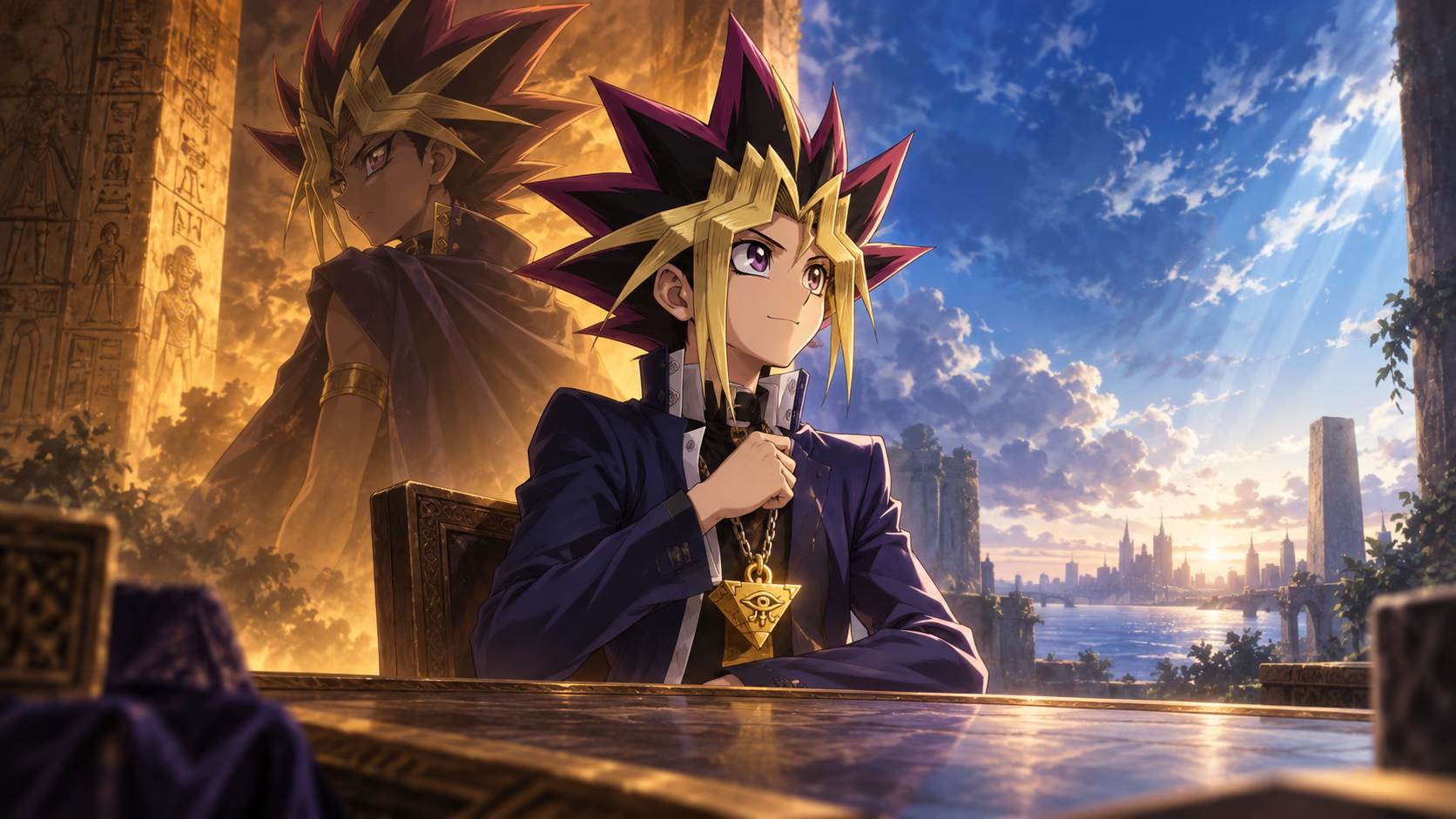
Minh họa Muto Yugi đứng trước bàn đấu, phía sau là Atem trong ánh sáng dịu, Millennium Puzzle kết nối hai người.
DuelIndex Editorial

Muto Yugi: The Duelist Who Learned to Stand on His Own

From solving the Millennium Puzzle to facing Atem himself, Yugi's journey unfolds through his decisions, signature monsters, and the final duel.

Muto Yugi is more than one half of the King of Games image. Behind Dark Magician, the Silent monsters, and Gandora the Dragon of Destruction lies the story of a Duelist developing an identity of his own. This article distinguishes Yugi from Atem, examines the roles of their associated cards, explores the significance of the Ceremonial Battle, and considers how classic designs have evolved in the modern trading card game.
← Articles
The familiar image of Yugi brings together distinctive hair, the Millennium Puzzle, and Dark Magician ready to enter the field. Yet that image contains the stories of two individuals: Muto Yugi and Atem. One is a student who loves games, while the other is an ancient Pharaoh's spirit carrying the responsibilities of his past. Their shared experiences define much of Yu-Gi-Oh!, but Muto Yugi's development cannot be understood simply by counting Atem's victories. To appreciate what happens when Yugi takes the field himself, we need to examine the choices he makes, the identity reflected by his cards, and why his final confrontation with Atem becomes a declaration of independence.

Cards featured in this article

Muto Yugi and Atem: Two Duelists Behind One Icon

Muto Yugi begins his story as a student with a particular love for games and puzzles. Completing the Millennium Puzzle connects him to the Pharaoh's spirit, later identified as Atem. In the Duel Monsters anime, Atem directly handles many of the best-known duels, while Muto Yugi remains an individual with his own thoughts, decisions, and development. Attributing every decision made by Atem to Yugi obscures an essential distinction between them. Dark Magician and Dark Magician Girl are closely associated with Atem throughout many encounters, but their presence does not establish that Muto Yugi personally controlled every memorable situation. The two characters share experiences and an extraordinary relationship without becoming a single competitive record. Recognizing this distinction reveals that Yugi's journey is not about becoming a replica of the Pharaoh. It is about discovering how to enter a duel as himself.

Cards mentioned
Conceptual editorial artwork for the topic, not evidence of a real-world event.

From Companion to Independent Duelist

Muto Yugi's growth does not occur in a single dramatic moment. Initially, his connection with Atem provides a companion capable of confronting challenges that Yugi lacks the confidence to handle alone. Sharing experiences, however, does not mean remaining permanently dependent. As the story progresses, Yugi develops the ability to make decisions, accept responsibility, and defend what matters to him. His development should therefore be examined through more than a count of victories: who actually participated in a duel, who selected an action, and what that choice meant are all essential questions. Monsters built around progression, such as Silent Magician and Silent Swordsman, offer an interesting thematic connection to personal growth, although symbolism should not be confused with a gameplay effect. The Ceremonial Battle brings this development to its conclusion. Yugi must face Atem, the companion who helped him through countless challenges, and demonstrate that he can continue through his own abilities.

Cards mentioned
Conceptual editorial artwork for the topic, not evidence of a real-world event.

Yugi's Deck: More Than a Familiar Face

Discussing Yugi's Deck requires distinguishing cards associated with the combined public image of the two characters from cards that more directly express Muto Yugi's individual journey. Dark Magician is central to many duels controlled by Atem, while Dark Magician Girl expands the magician imagery and the relationships between those monsters. Silent Magician, Silent Swordsman, and Gandora the Dragon of Destruction provide useful examples for exploring Muto Yugi's own identity, particularly toward the conclusion of the story. His Deck should not be imagined as one unchanging list containing every card that appeared across the manga and anime. Deck composition, card usage, and even the depiction of a monster can differ between story periods and adaptations. A central monster can pressure the field, a Spell can prepare resources, and a Trap can provide defensive options without any of them necessarily dealing immediate damage. A careful analysis therefore asks who is controlling the duel, when the card appears, and what strategic role it performs.

Cards mentioned

Signature Monsters: Strategic Roles Beyond ATK

With 2500 original ATK, Dark Magician is one of the most recognizable monsters associated with Yugi, but a Normal Monster cannot create an entire strategy through its statistics alone. Dark Magician Girl carries her own symbolic value through the magician theme. The Silent designs suggest another perspective: strength represented by development and responses to changing circumstances. Silent Magician must be distinguished from Silent Magician LV4 and Silent Magician LV8, just as the different Silent Swordsman versions must not be treated as cards with identical text. Gandora the Dragon of Destruction represents a different kind of intervention. In the TCG, Gandora the Dragon of Destruction can pay half its controller's LP to destroy and banish other cards on the field. It gains 300 ATK for each card destroyed this way, but cannot be Special Summoned and has an End Phase drawback if it was Normal or Flip Summoned that turn. This is a design with substantial impact balanced by explicit costs and limitations, rather than simply a monster with enormous printed ATK.

Cards mentioned
Mechanic explained

Gandora: Trading Resources for a Major Field Reset

How can a monster with zero original ATK fulfill an important strategic role?

  1. 1

    Deployment requirements

    Original ATK: 0

    Gandora the Dragon of Destruction cannot be Special Summoned. Its controller must account for the requirements of bringing it onto the field and the available LP.

Takeaway: Gandora demonstrates a major exchange of LP and monster longevity for field impact. Its practical value depends on deployment requirements and the resources affected.

Yugi's Strategic Thinking: Decisions Before Attack Points

One revealing way to examine Muto Yugi is to consider the actions he chooses not to take rather than focusing only on the final attack. A Duelist may preserve resources, prepare a response, or sacrifice access to one option to prevent an opponent from executing a more important plan. This perspective gives Yugi's cards meaning beyond their familiar appearances. Gold Sarcophagus and Monster Reborn in the Ceremonial Battle illustrate a predictive decision: Yugi prepares for a revival option that Atem might use. The significance lies in identifying an opponent's remaining route and being willing to relinquish that same route himself. A single example, however, cannot establish that Yugi follows an identical strategy in every duel. Accurate analysis must separate revealed information, resources actually available, timing, and the outcome shown in the particular version of the story. A decision that works within the narrative is not automatically a legal combination under present-day TCG card text.

Cards mentioned

The Ceremonial Battle: Yugi Faces Atem Himself

The Ceremonial Battle is a defining conclusion to the Duel Monsters anime because Muto Yugi's opponent is no longer someone he must defeat in an ordinary tournament. It is Atem himself. The confrontation asks whether Yugi can stand independently and allow his companion to return to the world beyond. In the anime, Atem brings all three Egyptian God Cards into the duel, creating a formidable challenge. Yet its significance extends beyond overcoming powerful monsters. In the Duel Monsters anime, Gold Sarcophagus seals Monster Reborn and stops Atem's revival attempt. The choice matters because Yugi not only prevents Atem's plan but also gives up his own opportunity to use that card under the mechanism depicted in the duel. Sealing revival becomes a narrative expression of farewell: Yugi can continue living and growing without keeping Atem beside him. The victory belongs to Muto Yugi, but the deeper meaning of the confrontation is the recognition of his independence and the completion of their shared journey.

Cards mentioned
Mechanic explained

Gold Sarcophagus in the Final Duel

Why does sealing Monster Reborn carry both strategic and narrative significance?

  1. 1

    Prepare the response

    1 sealed card

    Yugi uses Gold Sarcophagus to seal Monster Reborn through the special mechanism depicted in the anime duel.

Takeaway: This describes a narrative duel interaction, not a TCG ruling. Yugi's decision functions as both an anime strategy and a symbolic farewell.
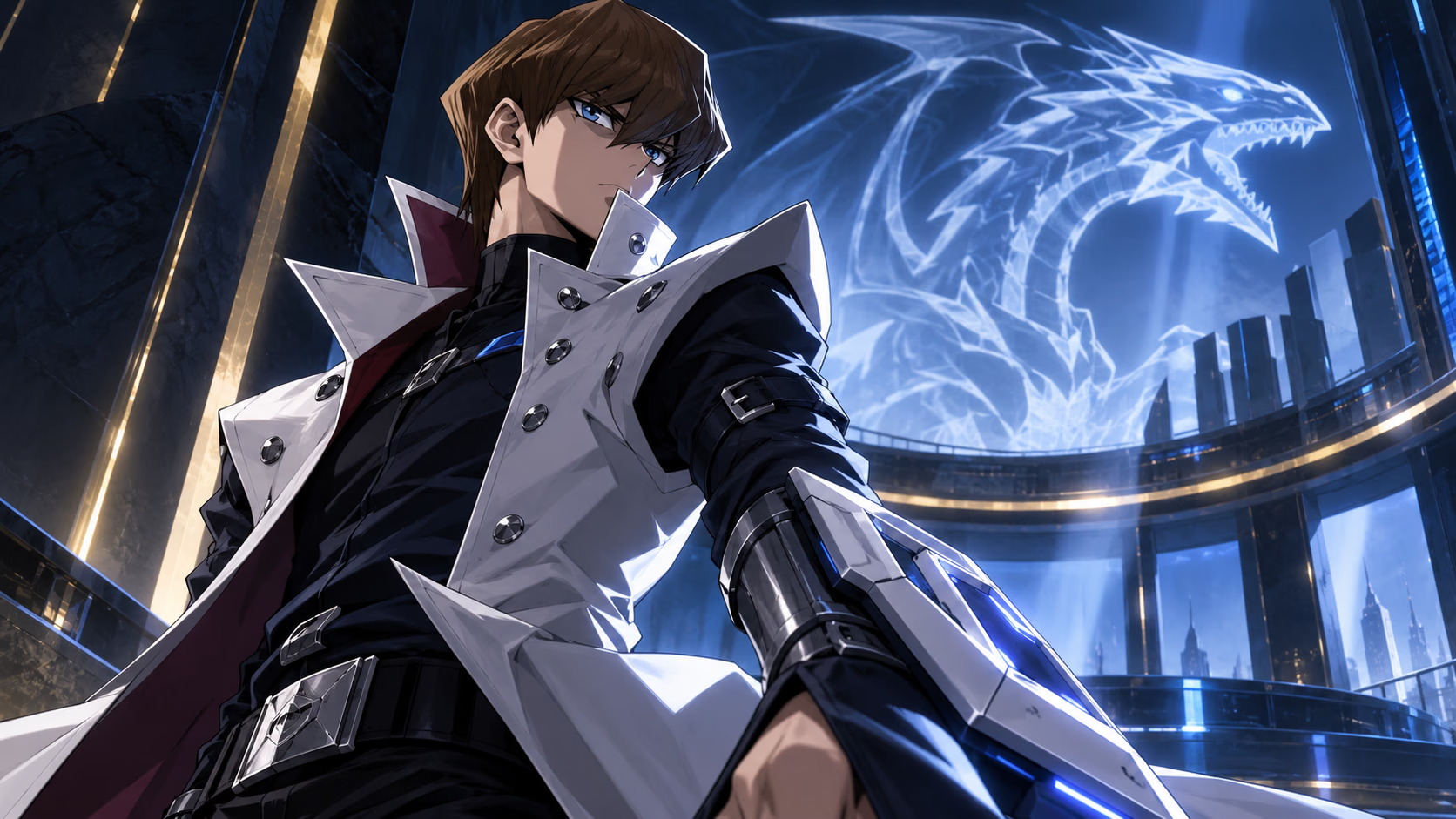
In the Ceremonial Battle, Yugi's longtime companion becomes his final opponent, giving him the opportunity to demonstrate his independence.

From Anime to TCG: Storytelling Power Is Not Card Text

A common mistake when revisiting Yugi's monsters is assuming that every effect shown in the manga or anime transfers unchanged into the official trading card game. Gold Sarcophagus is a clear example. In the physical TCG, Gold Sarcophagus banishes one card from the Deck face-up and adds it to the hand during the second Standby Phase after activation. Its TCG text does not let its controller seal a card name and automatically negate Monster Reborn as depicted in the Ceremonial Battle. Similarly, the Silent Magician and Silent Swordsman versions appearing in the anime must be distinguished from other officially named TCG versions. Silent Magician, without an LV suffix, is a separate monster: it has a Special Summon requirement involving Tributing a Spellcaster, gains 500 ATK for each card in its controller's hand, and can negate one Spell Card activation per turn. Any card analysis must identify the exact version, official English name, effect text, and applicable format. Narrative power serves the character's story; TCG interactions must be understood through the actual card text. The two perspectives complement one another but are not interchangeable.

Cards mentioned
Mechanic explained

Two Interpretations of Gold Sarcophagus

What changes when a narrative device becomes a physical TCG card?

  1. 1

    Narrative portrayal

    Anime mechanism

    Gold Sarcophagus seals Monster Reborn in the Ceremonial Battle through the duel's specific narrative mechanism.

Takeaway: A card can preserve its name and visual identity while operating differently in the story and the official game. Mechanical analysis must use the text of the exact card version.

Yugi's Monsters in Modern Play: From Icons to Support Systems

Classic monsters do not exist solely as reminders of the original story. Over successive periods of card development, related designs have gained additional methods of accessing resources, deploying monsters, and interacting with opponents. For Dark Magician, Magician's Rod can search a Spell or Trap mentioning Dark Magician when Normal Summoned. Dark Magical Circle offers access to relevant resources and can banish an opponent's card when Dark Magician is Normal or Special Summoned to the controller's field, subject to its effect restrictions. Eternal Soul can Special Summon Dark Magician from the hand or Graveyard, but carries a significant drawback if the face-up card leaves the field. These interactions show that a strategy is not defined by its central monster alone. Another development is Shining Sarcophagus, a design connecting several familiar Yugi-inspired themes. Shining Sarcophagus can search another card that mentions it from the Deck during the Main Phase, once per turn. Silent Magician Zero and Silent Swordsman Zero use Level progression and associated increases in power. Gandora-G the Dragon of Destruction can be Special Summoned from the hand while its controller controls Shining Sarcophagus and can pay half the controller's LP to destroy other cards on the field. Gandora-G the Dragon of Destruction must not be confused with Gandora the Dragon of Destruction, as they are distinct cards. These developments illustrate how character imagery can become a coordinated gameplay system, without independently establishing competitive results in any particular format.

Cards mentioned
Mechanic explained

How Shining Sarcophagus Connects Familiar Monsters

How can a Continuous Spell provide a shared structure for Yugi-inspired monsters?

  1. 1

    Establish the central card

    Once per turn

    Shining Sarcophagus is a Continuous Spell. During the Main Phase, its effect can add another card mentioning Shining Sarcophagus from the Deck to the hand, subject to its once-per-turn restriction.

Takeaway: Modern designs translate familiar Yugi imagery into conditional gameplay interactions, but the performance of the complete Deck must be assessed separately from nostalgia.
Familiar monster themes continue to evolve into coordinated gameplay systems, connecting memories of Yugi with modern card-playing experiences.

Muto Yugi's Legacy: A Victory Beyond the Result

Looking at Muto Yugi only through his monsters' highest ATK values misses what makes his journey distinctive. Dark Magician recalls his connection with Atem; the Silent designs suggest development; Gandora the Dragon of Destruction illustrates the potential impact of a difficult resource decision. By the Ceremonial Battle, the cards do more than provide methods of defeating an opponent. They help tell the story of a relationship between two individuals. Yugi's victory does not invalidate what Atem taught him. Instead, it demonstrates that their shared experiences have become abilities Yugi can exercise independently. Modern card designs continue to preserve these familiar themes across generations, but receiving new support is not the same as establishing superior competitive performance. Muto Yugi's legacy lies in the connection between character, decisions, and cards: someone who once needed a companion to face his greatest challenges eventually becomes capable of making his own choices, fighting his own duel, and taking the next step alone.

Cards mentioned

Key Takeaways

  • Muto Yugi and Atem are separate individuals. Atem's decisions and victories should not automatically be attributed to Muto Yugi.
  • Dark Magician and Dark Magician Girl are central to the broader Yugi image, while the Silent designs and Gandora help illuminate Muto Yugi's identity toward the story's conclusion.
  • A monster's strategic role depends on its Summoning requirements, effects, costs, and interactions, not simply ATK or DEF.
  • The Ceremonial Battle establishes Yugi's independence. The Gold Sarcophagus and Monster Reborn interaction carries both strategic and symbolic meaning within the narrative.
  • Effects portrayed in the manga or anime are not automatically TCG or OCG rulings. The exact official card version and text must be considered.
  • Cards such as Shining Sarcophagus, Silent Magician Zero, and Gandora-G the Dragon of Destruction develop familiar imagery into new coordinated gameplay systems.
  • Narrative legacy, gameplay functionality, and competitive effectiveness are distinct considerations that cannot be inferred directly from one another.

Frequently asked questions

Are Muto Yugi and Atem the same person?

No. Muto Yugi is the student who solves the Millennium Puzzle, while Atem is the Pharaoh's spirit connected to it. They share an extraordinary relationship and many experiences but remain separate individuals.

Is Dark Magician exclusively Muto Yugi's signature monster?

Dark Magician is an icon of the broader Yugi image and is especially associated with many duels controlled by Atem. Its appearances should not automatically be attributed to Muto Yugi's direct actions.

Which monsters help identify Muto Yugi's Deck near the end of the story?

The Silent Magician and Silent Swordsman designs, together with Gandora the Dragon of Destruction, are important examples. Narrative versions must be distinguished from specific TCG cards with their own official names and effects.

Why is the duel between Muto Yugi and Atem important?

The Ceremonial Battle tests Yugi's ability to stand independently and completes Atem's journey. Its meaning extends beyond an ordinary win-loss result.

Can the physical TCG version of Gold Sarcophagus negate Monster Reborn as shown in the anime?

No. Its TCG text banishes one card from the Deck face-up and adds it to the hand during the second Standby Phase after activation. It does not possess the anime's card-name sealing effect.

Are Dark Magician and Shining Sarcophagus Decks automatically strong in modern competitive play?

New support alone cannot establish that conclusion. A meaningful assessment requires a specified format and date, the applicable Forbidden & Limited List, consistency, resource retention, and relevant tournament evidence.

When Muto Yugi takes the field, the most important question is not which monster he can Summon that surpasses Atem's. It is whether he can recognize a situation, choose his own course, and accept the outcome through his own abilities. Dark Magician, the Silent monsters, Gandora, and their later counterparts all help preserve the image of Yugi, but the Ceremonial Battle brings his personal journey into focus. Yugi does not need to become a second Pharaoh. He only needs to demonstrate that the person who once stood beside Atem can now stand on his own.

Explore next

Find connected cards and decks in DuelIndex.

DUELINDEX · EDITORIAL

Read next