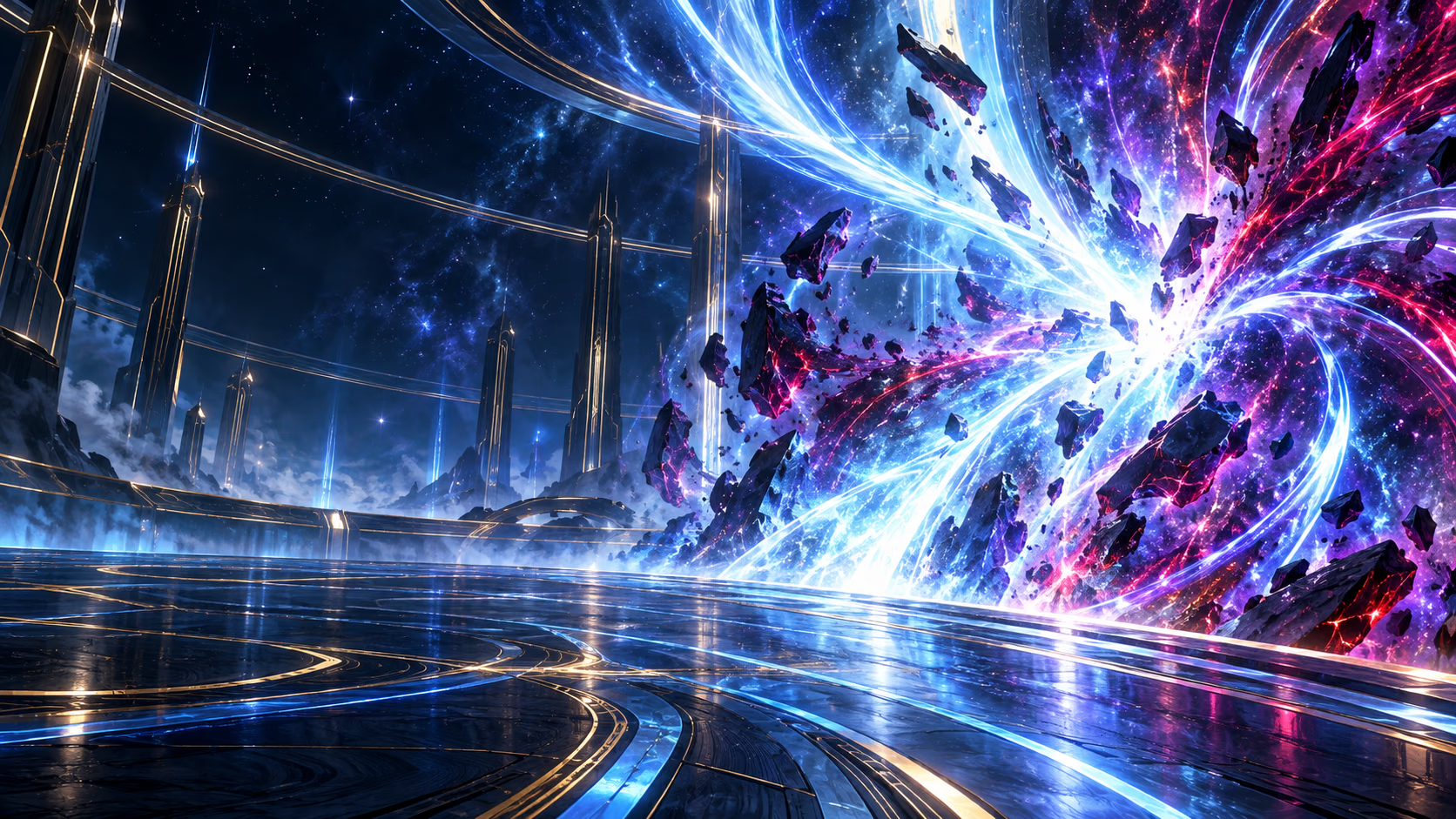
Rồng trắng mắt xanh xuất hiện trên đấu trường Duel Monsters, đối diện bóng dáng một pháp sư áo tím trong khung cảnh cao trào.
DuelIndex Editorial

When Boss Monsters Redefined the Board

Reading bosses through cost, interaction, and surviving resources

An independent study of four monster archetypes explaining why a boss cannot be measured by ATK alone, and why historical impact needs evidence.

← Articles
A memorable boss does more than occupy the center of the field: its arrival changes how both players choose their next action. From the iconic strength of Blue-Eyes White Dragon to Stardust Dragon, Number 101: Silent Honor ARK, and Borreload Savage Dragon, this article follows that evolution through card text and resource economics. These are editorial case studies of mechanics, not a ranking or a claim about tournament performance.

Cards featured in this article

When a boss becomes a strategic decision

Boss monster is a player-facing term rather than a formal card classification: it describes a monster that anchors or completes a plan. Blue-Eyes White Dragon illustrates the appeal of 3000 ATK and the legendary-dragon image, but raw ATK does not tell us whether a monster protects allies, interrupts an effect, or restores resources. Three questions make the term useful: what did the player spend to deploy it, which opponent decisions does its presence change, and what remains after it leaves the field? A monster with lower ATK can still be the center of a board if it changes the opponent’s order of play. This is an analytical framework, not a power ranking or an unsupported claim about a particular competitive format.

Cards mentioned

From a symbol of power to layered interaction

Blue-Eyes White Dragon is a Level 8 Normal Monster with 3000 ATK, a clear example of combat power as an identity. As Fusion, Synchro, Xyz, and Link expanded Extra Deck routes, materials, summoning conditions, and on-field effects became equally important parts of a boss’s identity. Stardust Dragon converts a Synchro Summon into a response to destruction effects. Number 101: Silent Honor ARK uses two Level 4 monsters to Xyz Summon and can turn a qualifying opposing monster into material. Borreload Savage Dragon connects Synchro play to a Link Monster in the Graveyard. Pendulum also reorganizes access to resources across hand, field, and face-up Extra Deck; these mechanics should not be flattened into one universal boss template.

Cards mentioned

The price of a boss goes beyond card count

Stardust Dragon requires one Tuner and at least one non-Tuner whose Levels total 8; its Synchro Materials normally leave the field for the Graveyard. Number 101: Silent Honor ARK needs two Level 4 monsters as Xyz Materials, then detaches two materials to use its effect that takes an eligible target. Borreload Savage Dragon likewise needs Synchro Materials and receives its additional layer of power only if a suitable Link Monster is in the Graveyard to equip when it is Synchro Summoned. Preparation of the Graveyard, Extra Deck space, and other monsters that could have remained on the field are also costs. Successfully Summoning a boss does not mean every effect has resolved successfully or that the opponent has lost all opportunities to respond.

Cards mentioned
Mechanic explained

Two layers of Extra Deck cost

Starting materials become access to an effect.

  1. 1

    Prepare

    2 Level 4

    Control two eligible Level 4 monsters.

Takeaway: Deployment and effect activation consume distinct layers of resources.

Five kinds of pressure, five distinct questions

Combat pressure changes how the opponent defends Life Points; Blue-Eyes White Dragon illustrates this dimension with 3000 ATK. Protective pressure appears when Stardust Dragon can Tribute itself in response to the activation of an effect that would destroy cards on the field; that scope does not cover every removal method. Resource-removal pressure comes from Number 101: Silent Honor ARK targeting an opponent’s face-up Attack Position Special Summoned monster and attaching it as material rather than simply destroying it. Borreload Savage Dragon applies negation pressure through Borrel Counters and an effect usable once per turn. A fifth kind is rebuilding pressure: the opponent must consider whether removing the boss also stops the supporting engine. Each dimension asks for a different answer, so counting effect lines alone cannot describe a boss’s role.

Cards mentioned
Mechanic explained

Protection is not immunity

Track the exact trigger for Stardust Dragon.

  1. 1

    Identify

    Condition

    A card or effect is activated that would destroy cards on the field.

Takeaway: Read the exact operation before relying on this protection.

One monster and the machinery behind it

A Main Deck commonly supplies starters, extenders, or access to required resources; the Extra Deck must reserve space for the destination monster and any intermediate steps. Borreload Savage Dragon is a particularly clear example: its text calls for a Link Monster in the Graveyard to equip and generate Borrel Counters. Evaluating only the dragon while ignoring the route that puts a Link Monster there misses an operating requirement. For Number 101: Silent Honor ARK, two Level 4 monsters are the access cost and two materials are the cost of activating its targeted removal effect. Where the format allows one, a Side Deck can address different threat categories. The last monster on a board should not receive all credit for the engine, and a single decklist cannot establish that a card dominated a metagame.

Cards mentioned

Reading two moments of the same board

A useful board reading starts with verifiable resources rather than an invented duel. For Number 101: Silent Honor ARK, distinguish the two Level 4 monsters before an Xyz Summon from their status as two materials under the new monster afterward; using the targeting effect detaches both. If that effect resolves with an eligible target, the opposing monster becomes material. The change concerns resource type and board access, not an invented Life Point reduction. With Stardust Dragon, Synchro Materials leave the field and the new monster can respond to a qualifying destruction effect. These are structural examples, not reconstructions of a particular turn or tournament outcome; accordingly no unknown LP totals, opposing cards, or board slots are assigned.

Cards mentioned

Every wall has a defined scope

Counterplay starts by reading the verbs in the card text: destroy, negate, attach as material, and other zone changes are different operations. Stardust Dragon responds to the activation of a card or effect that would destroy cards on the field; it does not automatically cover every way to remove a monster. Number 101: Silent Honor ARK must target an opponent’s face-up Attack Position monster that was Special Summoned to use its attaching effect. Borreload Savage Dragon needs a Borrel Counter to negate an activation, and that effect is limited to once per turn. An analysis must distinguish stopping the setup, responding to an activation, and dealing with an established monster. No broad description alone establishes a ruling for every possible chain.

Cards mentioned
Mechanic explained

Counters are finite resources

Separate the counter requirement from the once-per-turn limit.

  1. 1

    Prepare

    Link Rating

    Synchro Summon and equip a Link Monster from the Graveyard through its effect.

Takeaway: Having multiple counters does not bypass the once-per-turn restriction.

What is actually lost when a boss leaves?

A boss can embody several kinds of value: materials spent, field space, effects still available, and the opponent’s actions needed to remove it. Stardust Dragon has a return route written on the card itself: if its self-Tributing effect was activated that turn and not negated, it can be Special Summoned from the Graveyard during the End Phase. That is not a blanket promise to return whenever it leaves the field. Number 101: Silent Honor ARK can detach one material instead if the face-up card would be destroyed by battle or card effect, subject to its stated condition. A deck may rebuild through other resources, but resilience on the monster and recovery supplied by the wider engine are separate properties.

Cards mentioned

Why a boss changes with its environment

A changing card pool alters both the route to a boss and the available answers after it arrives. Protection against destruction means something different when opponents have more ways to remove a monster without destroying it; counter-based negation also depends on how the deck supplies counters. Rules, Extra Deck procedures, and Forbidden & Limited Lists differ between TCG, OCG, and Master Duel and across dates. Three separate questions therefore matter: was the card legal in that environment on that date, did real decks actually use it, and what period-specific competitive evidence describes its impact? A change to a list cannot automatically be attributed to one monster, and these case studies should not be described as format-dominating without matching evidence.

Iconic legacy and the lesson of board design

Blue-Eyes White Dragon has a recognizable cultural identity, but cultural visibility does not itself prove the competitive performance of every version of its deck. Stardust Dragon makes destruction protection central to its mechanical identity; Number 101: Silent Honor ARK shows how Xyz Materials are both an investment and a cost; Borreload Savage Dragon shows that an end-board monster can depend on a Link resource previously placed in the Graveyard. Taken together, these examples present a boss as more than a visually impressive destination. It changes how players allocate resources, anticipate responses, and plan recovery. The enduring lesson is how each design raises a distinct question about the board, not which monster deserves an all-time superlative.

Cards mentioned

Key Takeaways

  • Boss monster describes a strategic role, not an official card type or a raw ATK threshold.
  • Summoning costs include materials, preparation, Extra Deck space, and opportunity cost.
  • Stardust Dragon, Number 101: Silent Honor ARK, and Borreload Savage Dragon exert different forms of pressure with defined limits.
  • Separate a boss’s own properties from its engine and the deck’s ability to rebuild.
  • Historical impact requires date-, format-, card-pool-, and evidence-specific analysis.

Frequently asked questions

Is boss monster an official card type?

No. It is a description of a strategic centerpiece or destination; printed card types remain distinct.

Does Stardust Dragon stop all removal?

No. Its response concerns activation of a card or effect that would destroy cards on the field; other methods must be considered separately.

Can Number 101: Silent Honor ARK target any monster?

No. Its attaching effect requires an opponent’s face-up Attack Position Special Summoned monster and detaching two materials.

Do multiple Borrel Counters mean multiple negations per turn?

No. The negation effect of Borreload Savage Dragon is limited to once per turn.

Can a boss’s effect alone prove historical dominance?

No. Period-specific decklists, data, and format context are needed; recognition is not competitive evidence.

To read a boss monster is to read the decisions surrounding it: resources before the Summon, pressure afterward, the opponent’s responses, and the path to rebuilding. Those relationships, rather than ATK or fame alone, tell the strategic story of a boss.

Explore next

Find connected cards and decks in DuelIndex.

DUELINDEX · EDITORIAL

Read next