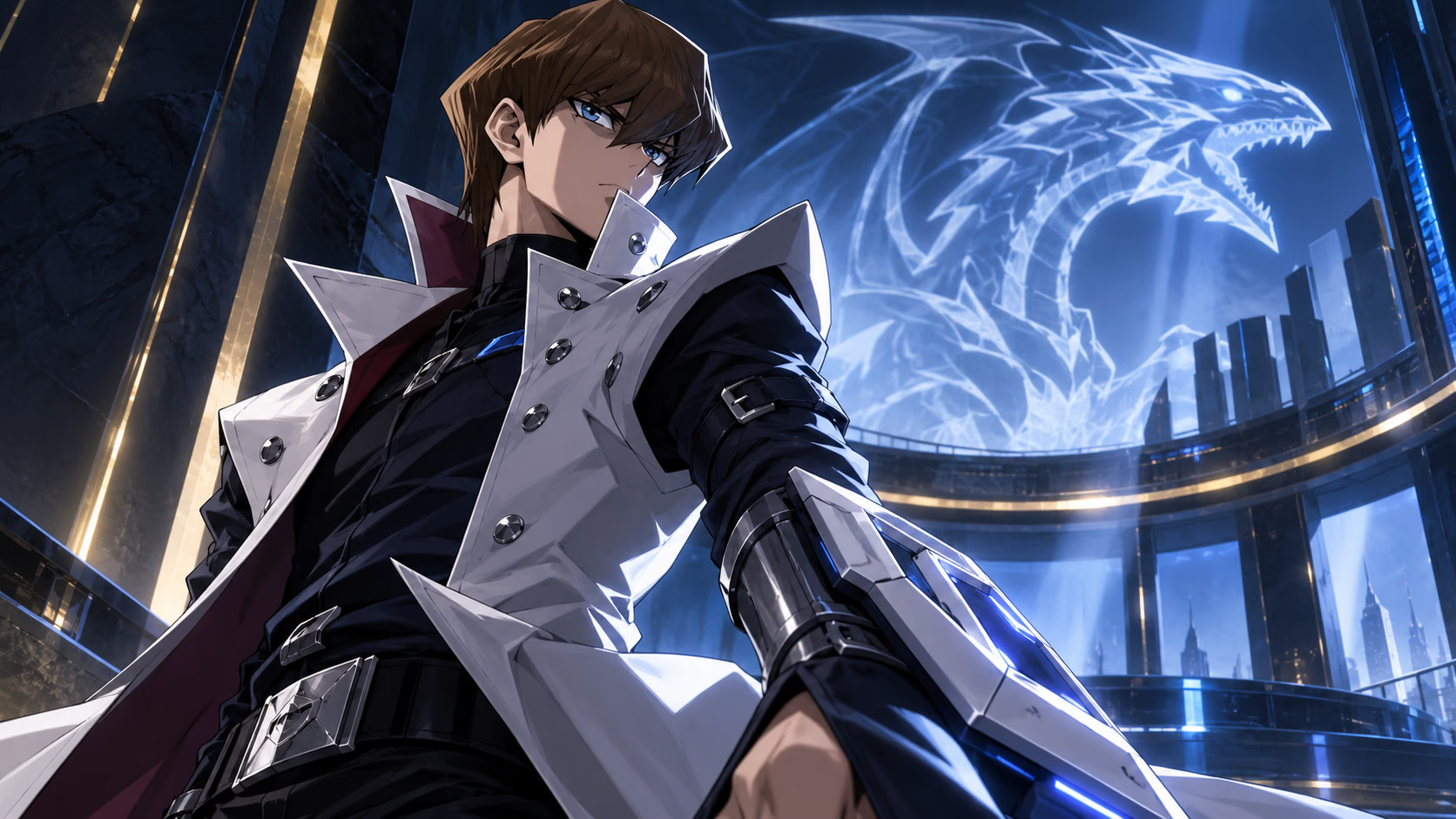
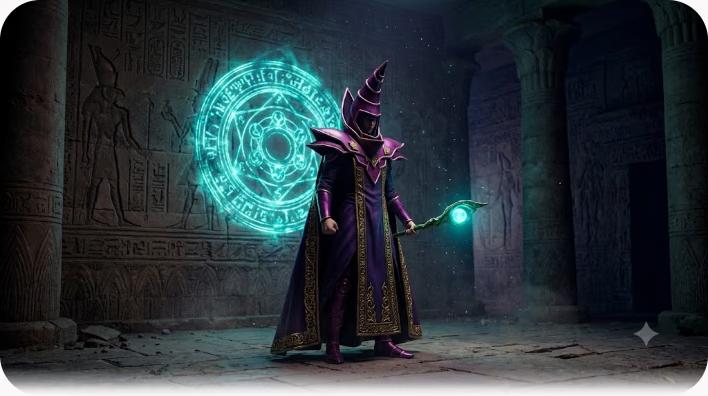
Hình minh họa vị pháp sư huyền thoại trong trang phục tím sẫm đứng trước vòng tròn ma pháp cổ Ai Cập phát sáng
DuelIndex Editorial

Understanding Dark Magician: From Ancient Lore to Modern Control

A look at the iconic monster, its dedicated support, and evolving deckbuilding approaches.

An in-depth tactical overview of the Dark Magician archetype, exploring its Egyptian lore roots, early mechanical hurdles as a Normal Monster, the 2016 control revamp, turn-one board operations, the impact of Red-Eyes Dark Dragoon, and modern hybrid synergies.

← Articles
Dark Magician remains an iconic centerpiece of trading card game history, yet its tabletop reality differs vastly from animated portrayals. This guide details the archetype's tactical trajectory, dissecting how ancient lore translated into game design, why early vanilla stats held it back, how 2016 support forged a recursive control loop, and how modern pilots leverage hybrid engines to compete.

Cards featured in this article

Ancient Egyptian Origins: Mahad’s Loyalty and the Birth of Dark Magician

In ancient Egypt, Mahad served as a Priest wielding the Millennium Ring, standing as both the childhood friend and the most fiercely loyal guardian of Pharaoh Atem. When Thief King Bakura raided the previous pharaoh's royal tomb, Mahad lured the intruder into a deadly trap alone to eliminate the imminent threat to the dynasty. Recognizing that the dark powers were overwhelming, he resolved to spring the tomb's crushing mechanism upon himself, sacrificing his life to fuse his soul with his own Ba monster, Illusion Magician. This tragic sacrifice gave birth to Dark Magician, forging an eternal oath of protection that transcended the boundary between life and death. Consequently, in the original manga canon, Dark Magician is never merely an unfeeling battle card, but the living incarnation of Mahad's absolute loyalty and unyielding will dedicated to the Pharaoh. This spiritual bond is directly commemorated in the card Palladium Oracle Mahad, faithfully capturing the exact awakening of his power to protect Atem.

Cards mentioned
Mechanic explained

The Transformation into the Eternal Royal Guardian

The genesis of Dark Magician stems from Mahad's ultimate self-sacrifice during his fated confrontation in the ancient tomb.

  1. 1

    Ambush at the Royal Tomb

    Priest wielding the Millennium Ring

    Mahad deliberately lured Thief King Bakura into the tomb of the prior pharaoh to thwart his plunder of treasures and protect Atem's reign.

Takeaway: Dark Magician represents the immortalized soul of Mahad, embodying an eternal pledge of guardianship toward Pharaoh Atem across thousands of years.

The Early Era: An Anime Icon and the Limits of a Normal Monster (1999–2015)

Although famously tied to Yugi Muto's spectacular victories in the anime, Dark Magician suffered from severe, fatal disadvantages in real-world competitive play. As a Level 7 Normal Monster with 2500 ATK, summoning it required a Tribute Summon cost of two monsters, making it far more expensive than Summoned Skull, which required only one monster while achieving the exact same 2500 ATK. Lacking any inherent card effect, Dark Magician often turned into an unplayable brick in hand without immediate tribute fodder. Early support options like Skilled Dark Magician or Dedication through Light and Darkness relied on cumbersome requirements such as accumulating spell counters or overcommitting field resources. Furthermore, the signature spell pair Dark Magic Attack and Thousand Knives completely lacked dedicated search tools during that era, leaving the entire archetype inconsistent and unable to compete in the meta.

Cards mentioned
Mechanic explained

The Disconnect Between Anime and the Meta Game

Tremendous on-screen popularity created an illusion of strength, whereas the underlying game mechanics suffered from numerous fundamental flaws.

  1. 1

    Unfavorable Tribute Cost

    2 Tributes versus 1 Tribute

    Requiring two tributes to reach 2500 ATK left the monster completely outclassed by Level 6 monsters with identical attack power.

Takeaway: Overwhelming anime dominance was a narrative device; actual competitive play demanded resource efficiency that early Dark Magician simply could not deliver.

The Archetype Breakthrough: Control Through Circle and Navigation (2016)

The release of the booster set The Dark Illusion in 2016 completely redefined Dark Magician from a disjointed deck into a dedicated Control strategy. The core engine revolving around Dark Magical Circle and Magician Navigation enabled duelists to establish continuous disruption setups during the opponent's turn. Whenever Magician Navigation or Eternal Soul resolves to Special Summon Dark Magician, the trigger effect of Dark Magical Circle immediately allows the player to banish 1 card the opponent controls without destroying it. At the Yu-Gi-Oh! World Championship 2016 in Tokyo, competitor Shunsuke Hiyama leveraged the unified TCG and OCG forbidden and limited list to pilot the Dark Magician engine in top-tier competition, exploiting its pinpoint card removal alongside the in-graveyard Spell/Trap negation of Magician Navigation to shut down the Blue-Eyes meta and secure a historic championship title.

Cards mentioned
Mechanic explained

Disruption Mechanics of Dark Magician During the Opponent's Turn

The combination of Continuous Spells and reactive Traps enables the archetype to dominate board control without relying on raw combat attack values.

  1. 1

    Reactive Summon Activation

    1 opponent's turn

    Activate a previously Set Magician Navigation or trigger Eternal Soul to Special Summon Dark Magician to the field directly during the opponent's Main Phase.

Takeaway: Dark Magician transformed from an average Vanilla monster into an active trigger piece for high-impact, targeted disruptions.

A Practical Board Example: How the Traditional Control Engine Works

A standard opening hand for a pure Dark Magician deck establishes a turn-one end board designed to dictate the pacing of the duel. Specifically, the pilot sets up Dark Magical Circle face-up, alongside set copies of Eternal Soul and Magician Navigation in the backrow, while Magician's Rod remains present on the field. The deck's primary strength lies in its exceptionally resilient resource loop. On each turn, Eternal Soul can reliably revive Dark Magician directly from the Graveyard (GY), immediately triggering Dark Magical Circle to banish a target card controlled by the opponent. Concurrently, Magician's Rod resting in the GY can cycle itself back to hand by Tributing an on-field Spellcaster monster. Nevertheless, a fatal vulnerability persists in the strategy's heavy over-reliance on Eternal Soul. If this Continuous Trap is targeted and eliminated by prevalent backrow removal staples like Harpie's Feather Duster or Cosmic Cyclone, its mandatory self-destruction clause triggers instantly, completely wiping out all monsters on your side of the field and causing the entire board state to collapse.

Cards mentioned

The Red-Eyes Dark Dragoon Era: A Boss Used Beyond Its Archetype

Red-Eyes Dark Dragoon stands out as one of the most complete Fusion Monsters in all of Yu-Gi-Oh! thanks to its formidable built-in protection: it cannot be targeted or destroyed by card effects. On top of that, it boasts an omni-negate that can shut down any opponent's Spell, Trap, or monster effect activation, while simultaneously gaining ATK and inflicting overwhelming burn damage to the opponent's Life Points. Although intentionally designed as a flagship boss monster for the Dark Magician strategy, Dragoon was quickly hijacked by top meta decks through Predaplant Verte Anaconda. By simply paying 2000 LP, Verte Anaconda copies the effect of Red-Eyes Fusion, sending Dark Magician and Red-Eyes Black Dragon straight from the Main Deck as Fusion Material. This dynamic turned Dark Magician into an unfortunate brick, demoting its role from a beloved centerpiece to mere engine fodder. The eventual ban of Red-Eyes Dark Dragoon in the OCG was an inevitable consequence, which stripped pure Dark Magician decks of their ultimate shield and forced the archetype to completely restructure its traditional control playstyle.

Cards mentioned

Hybrid Variants and Modern Deckbuilding Approaches

To address its inherently slow board setup and lack of native negates, modern Dark Magician builds frequently integrate supplementary engines such as Branded or Invoked. The Branded Dark Magician variant utilizes Branded Fusion to send materials directly from the Deck to summon Lubellion the Searing Dragon, which subsequently fuses into Mirrorjade the Iceblade Dragon to establish formidable disruption, or pivots directly into The Dark Magicians for sustained resource cycling. Consistency and hand correction issues are comprehensively resolved through Illusion of Chaos: by activating its effect in hand to search Magician's Souls, players can send Dark Magician straight to the GY to draw up to two cards, while Magikuriboh acts as an interactive hand trap to revive the Dark Magician whenever damage is taken. Despite these streamlined lines, Dark Magician fundamentally remains a nostalgic casual-to-rogue archetype, struggling to compete head-to-head in top-tier competitive metas due to an over-reliance on external engine extenders and acute vulnerability to widespread generic hand traps interrupting its core combo sequence.

Cards mentioned

Key Takeaways

  • Dark Magician originated from Priest Mahad sacrificing his life against Thief King Bakura, fusing his soul with his Ba to safeguard Pharaoh Atem.
  • From 1999 to 2015, Dark Magician lacked competitive viability due to its Level 7 two-tribute cost, leaving it outclassed by single-tribute monsters like Summoned Skull.
  • The 2016 booster set The Dark Illusion reshaped the deck into a dedicated control system through Dark Magical Circle and Magician Navigation.
  • The core board state relies on continuous recursion via Eternal Soul, triggering Dark Magical Circle on both turns to repeatedly banish opponent resources.
  • Red-Eyes Dark Dragoon offered built-in targeting and destruction immunities, omni-negation, ATK scaling, and burn damage, leading to heavy external engine adoption.
  • Modern builds incorporate engines such as Branded or Invoked to mitigate initial setup delays and provide resilient disruptions without relying solely on pure traps.

Frequently asked questions

What is the primary interaction behind the Dark Magician control loop?

The strategy hinges on special summoning Dark Magician during either turn via Eternal Soul or Magician Navigation, which directly triggers the effect of Dark Magical Circle to banish a card controlled by the opponent.

Why was Dark Magician considered inefficient prior to modern support?

As a Level 7 Normal Monster with no inherent effects, it required two tributes for 2500 ATK, matching the offensive presence of Summoned Skull, which required only a single tribute and caused far fewer brick hands.

What tools give Red-Eyes Dark Dragoon its formidable field presence?

It features innate immunity against targeting and effect destruction, possesses an omni-negate that cancels opponent activations while gaining ATK, and applies direct burn damage to the opponent's Life Points.

How does integrating the Branded engine improve modern Dark Magician decks?

Branded Fusion sends fusion materials straight from the deck to access powerful lines such as Lubellion the Searing Dragon into Mirrorjade the Iceblade Dragon or The Dark Magicians, accelerating board presence without relying solely on slow backrow setups.

Dark Magician transitioned from a cumbersome tribute monster into an intricate backrow control strategy governed by recurring graveyard loops and precise banishing effects. By pairing the core engine with contemporary fusion options, pilots can overcome historic setup vulnerabilities and navigate high-tempo competitive environments.

Explore next

Find connected cards and decks in DuelIndex.

DUELINDEX · EDITORIAL

Read next